Aetheria: The Ashen Crown
Roll a life. Live it. Lose it for good.
Aetheria is a fantasy RPG about one adventurer and everyone who follows them. You don't build a character — the dice do. Blood, calling, upbringing and face all come off the same throw. Reroll as long as you like, but you can't pick and mix. What you become is decided later, one level at a time.
Death is permanent. If you fall, the run is over and the save is gone. A companion who dies stays dead: no temple, no reload, no second chance. What survives is the ledger — every life that ended — and a new adventurer can be born carrying one thing a past life knew, at a price they pay for the rest of their days.
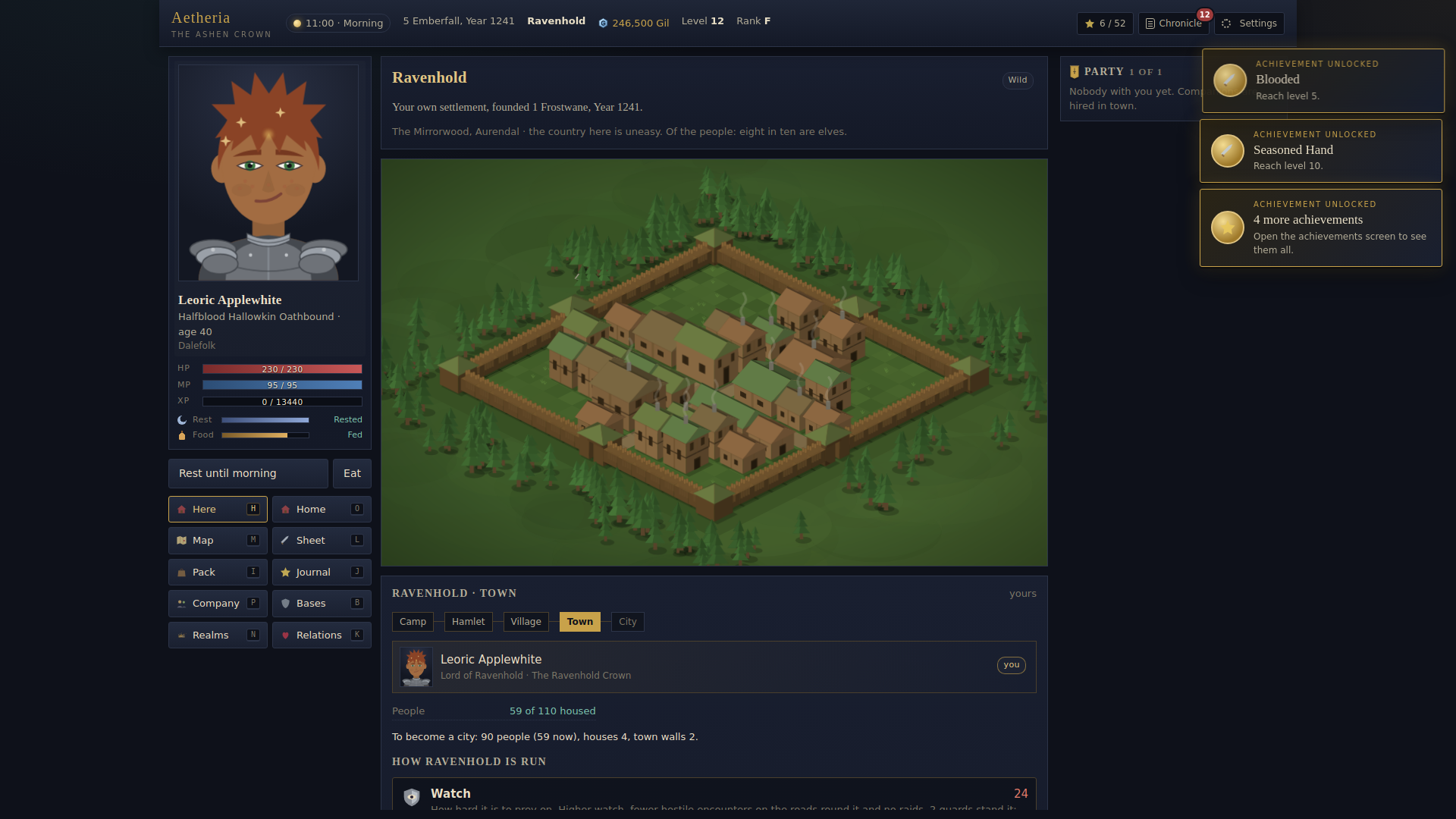

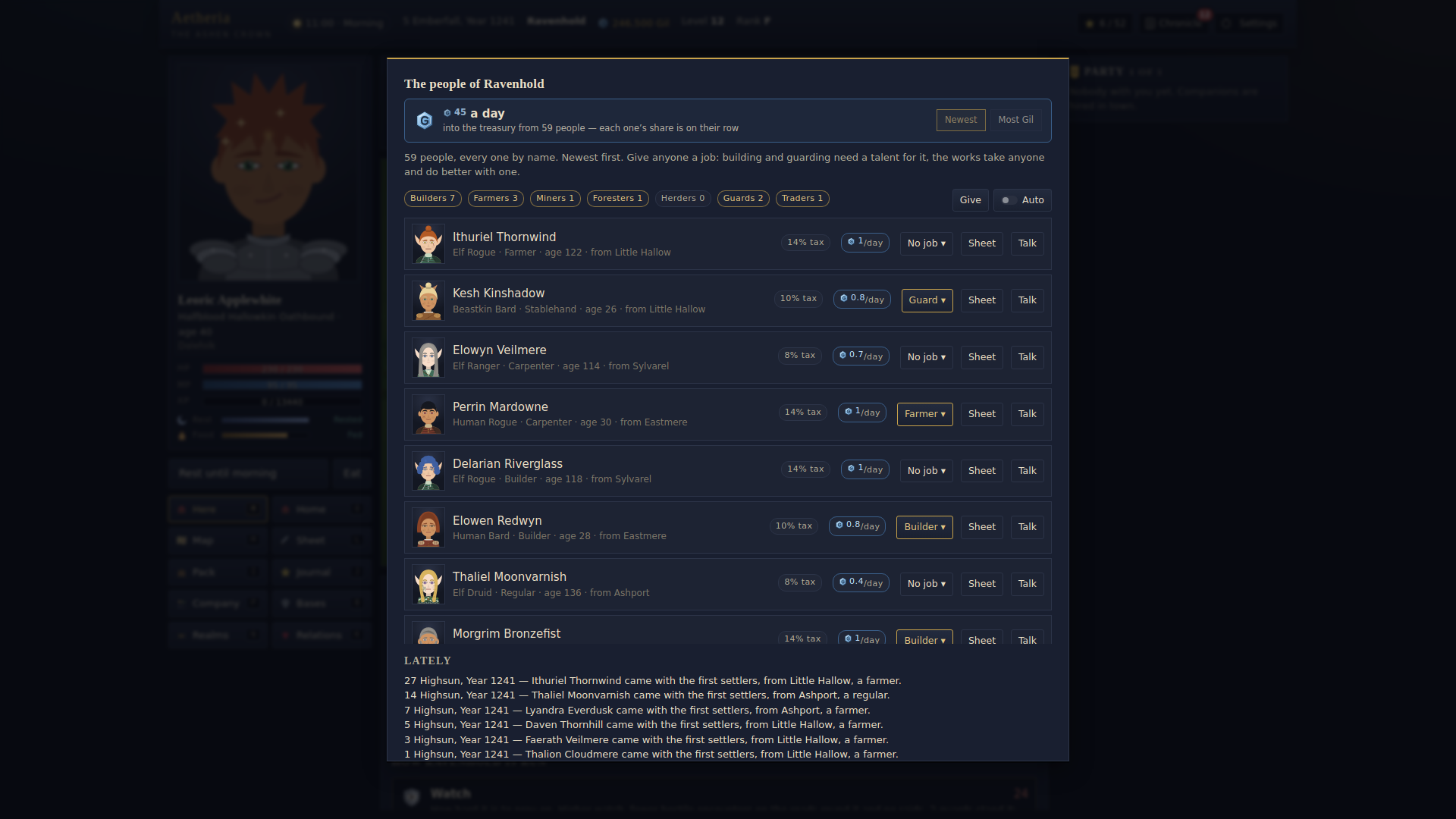
v0.3 let you found a settlement. It was a number that went up. In v0.4 a settlement is the people in it — each one somebody who arrived on a day, from a town, with a trade and a family and a sheet you can open. Somebody has to build the buildings. Somebody has to work the fields. Lay out your town street by street, set your residents to trades, write its laws and tax it. The seven realms of the world became real powers with monarchs, treasuries and grudges. And death stopped being the end: you can be born again into this same world, as a baby, and wait sixteen years to grow up while everything carries on without you. Full notes in the devlog.

Eight peoples, twenty-six bloodlines, and mixed heritage is normal. Any blood that makes up 40% of you grants its gift, so a half-elf carries two. Your bloodline wakes as you live — Dormant, Stirring, Awakened, Ascendant, Apex — and at its peak it becomes something else: a dragon form, the Old Forest, the Red Rampage, a king's word nobody can refuse.
Children inherit alleles for skin, hair, eyes, height, build and temper from both parents. Recessives skip a generation. Your heir may look nothing like you and fight exactly like your grandmother.
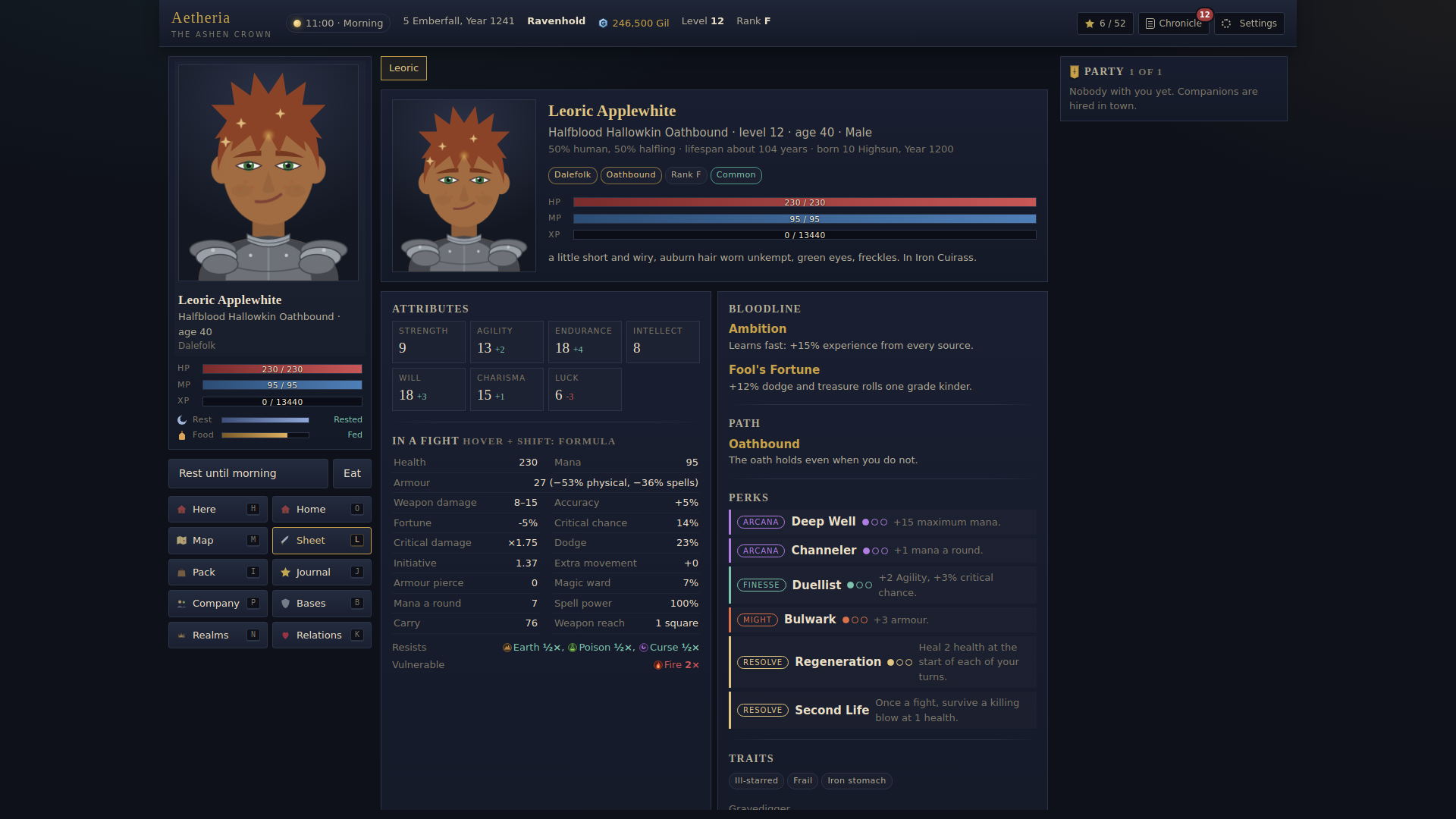

Twelve callings, a specialisation at level five, and a real decision at every level: two attribute points and one of three things your calling and blood could teach you. Perks now come in four schools — Might, Finesse, Arcana, Resolve — each up to three ranks deep.
Spells across 13 schools — four elements, six melded pairings (steam, magma, ice, sand, lightning, mud) and the will-craft of healing, blessing and curse.
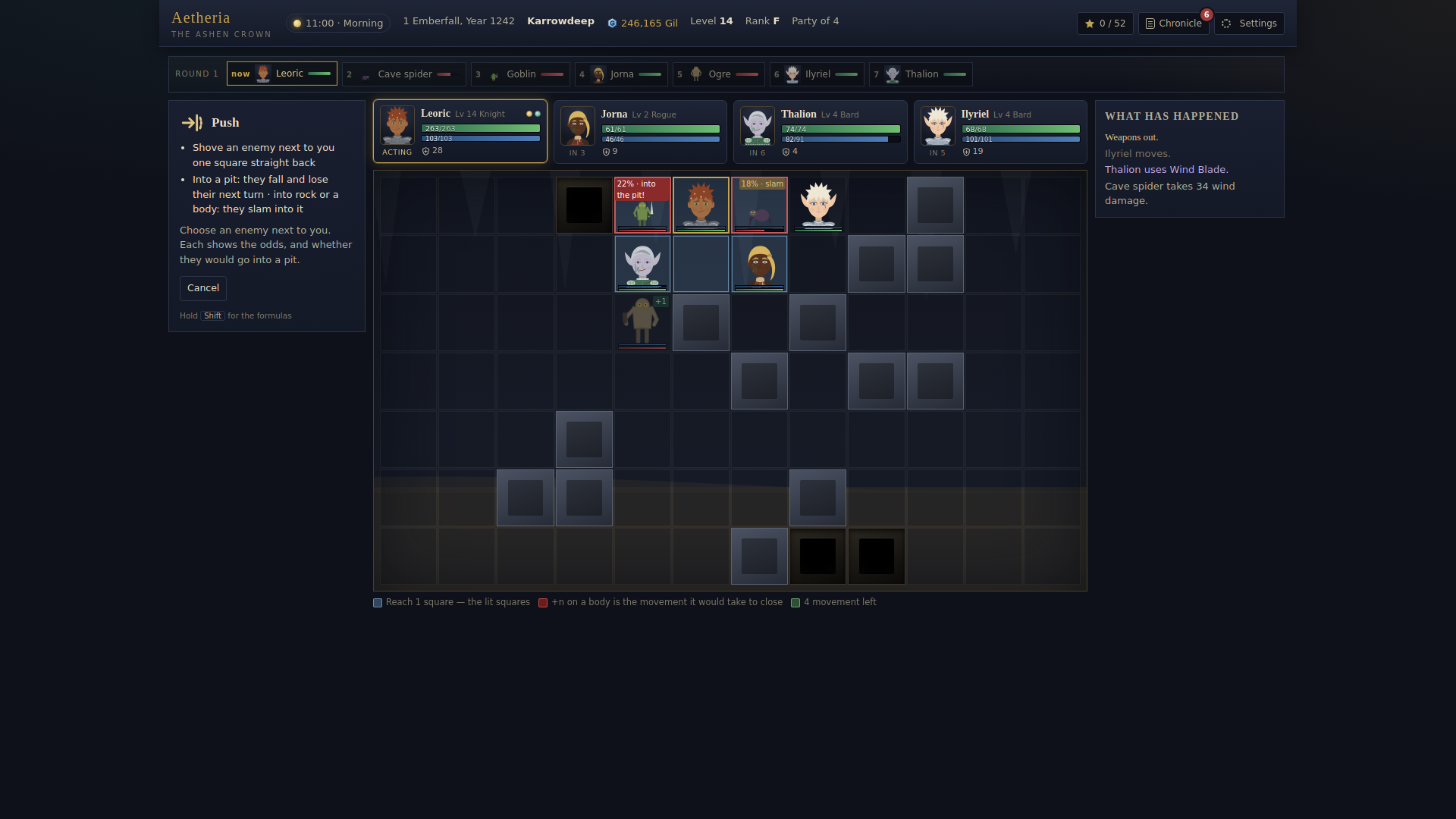
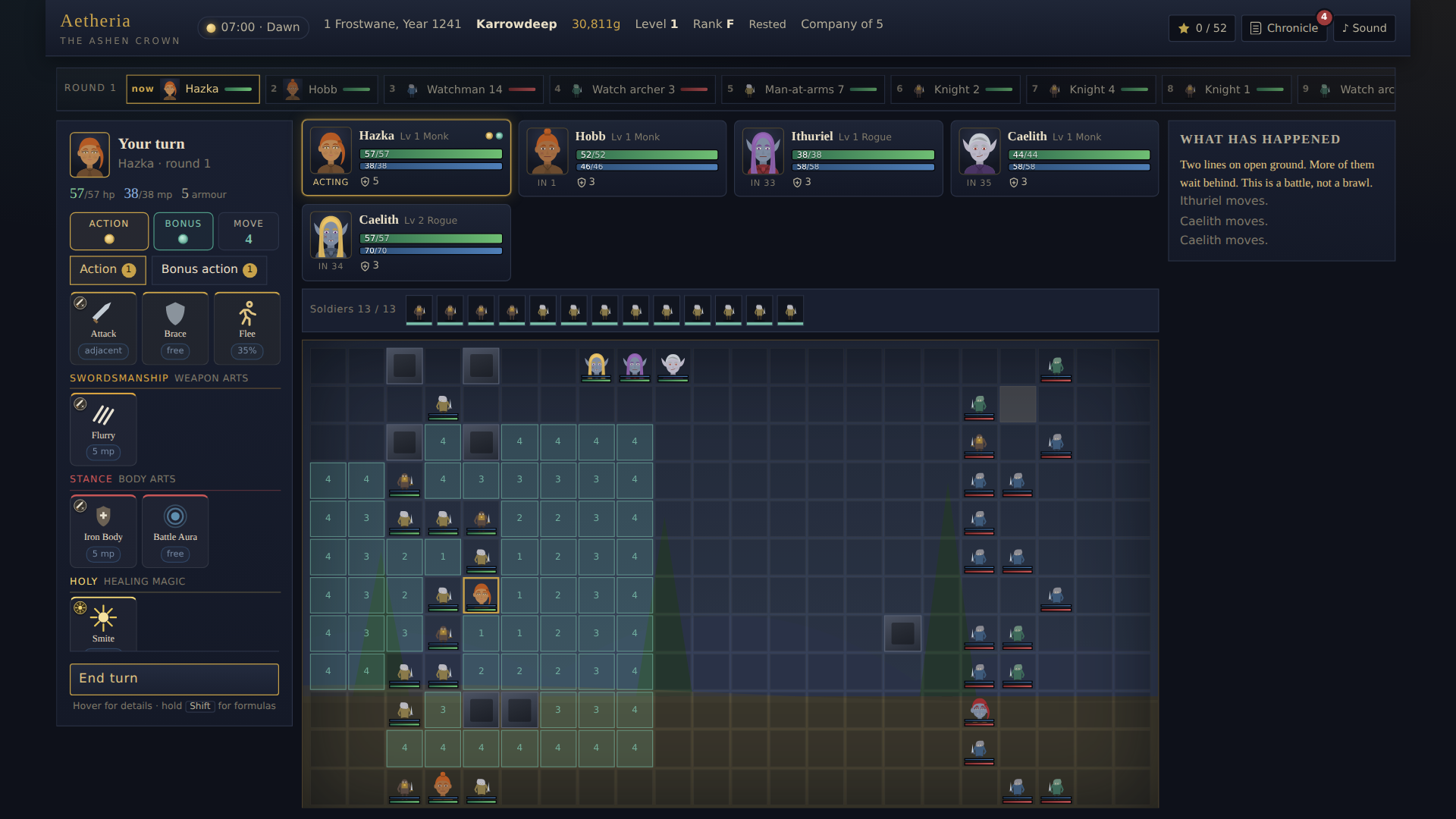
Tactical grid combat on ground generated for wherever you're standing: rock, walls and pillars for cover, pits in the floor, mud that drags, braziers that burn. Shove an enemy into a pit, jump a gap, take wing if you have them, or put a shot through three of them in a line. Every number shows its formula — hover anything and hold Shift.
Every weapon now attacks its own way — a sword swings, a spear thrusts, an axe chops down, a crossbow's quarrel flies flatter than an arrow — and every monster is drawn in two layers, body and weapon arm, so it turns to face you and brings its blow round onto the square you're standing on.

Two continents, a week of open sea between them, twelve towns and fourteen stretches of wild country, each painted as its own place under a sky that follows the clock. Everyone you meet is a particular person with a past, a fear, something they want and people they're tied to. They remember what you did. Every week merchants come through, travellers stay, households move town, companies form and fall apart, blights and gluts hit the markets, and raiders find the roads where the watch is thin — all of it written into the history of the place it happened.
There is a clock. Shops shut at night, the roads get worse after dark, and fatigue and hunger take your numbers off you until you sleep and eat.
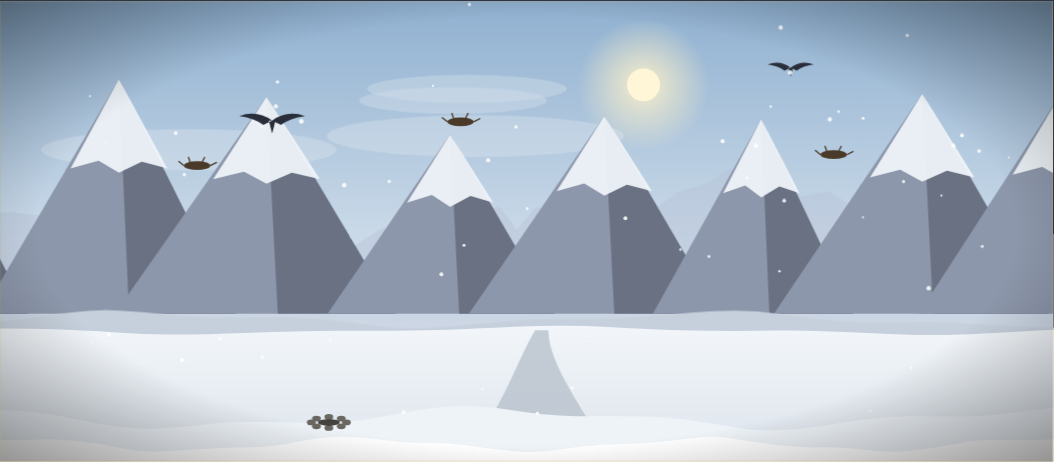
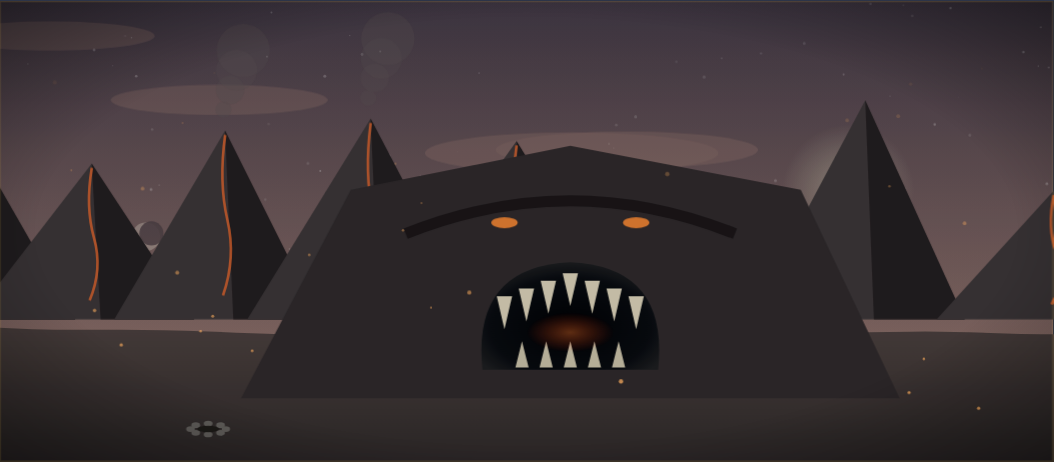

Click anywhere on the map — a town, a delve, or empty country — and see the way, the days and the food it will cost before you set out. Your company crosses the map a day at a time: on foot, or in a handcart, mule cart, horse cart, covered wagon or war wagon. You camp each night and eat from the stores you carry. The road puts things in your way: bandits wanting a toll, a merchant's wagon, a family with nothing, a wreck in the ditch, a storm, another company under its banner. Out in the wild, forage, fish and hunt to keep the stores full.
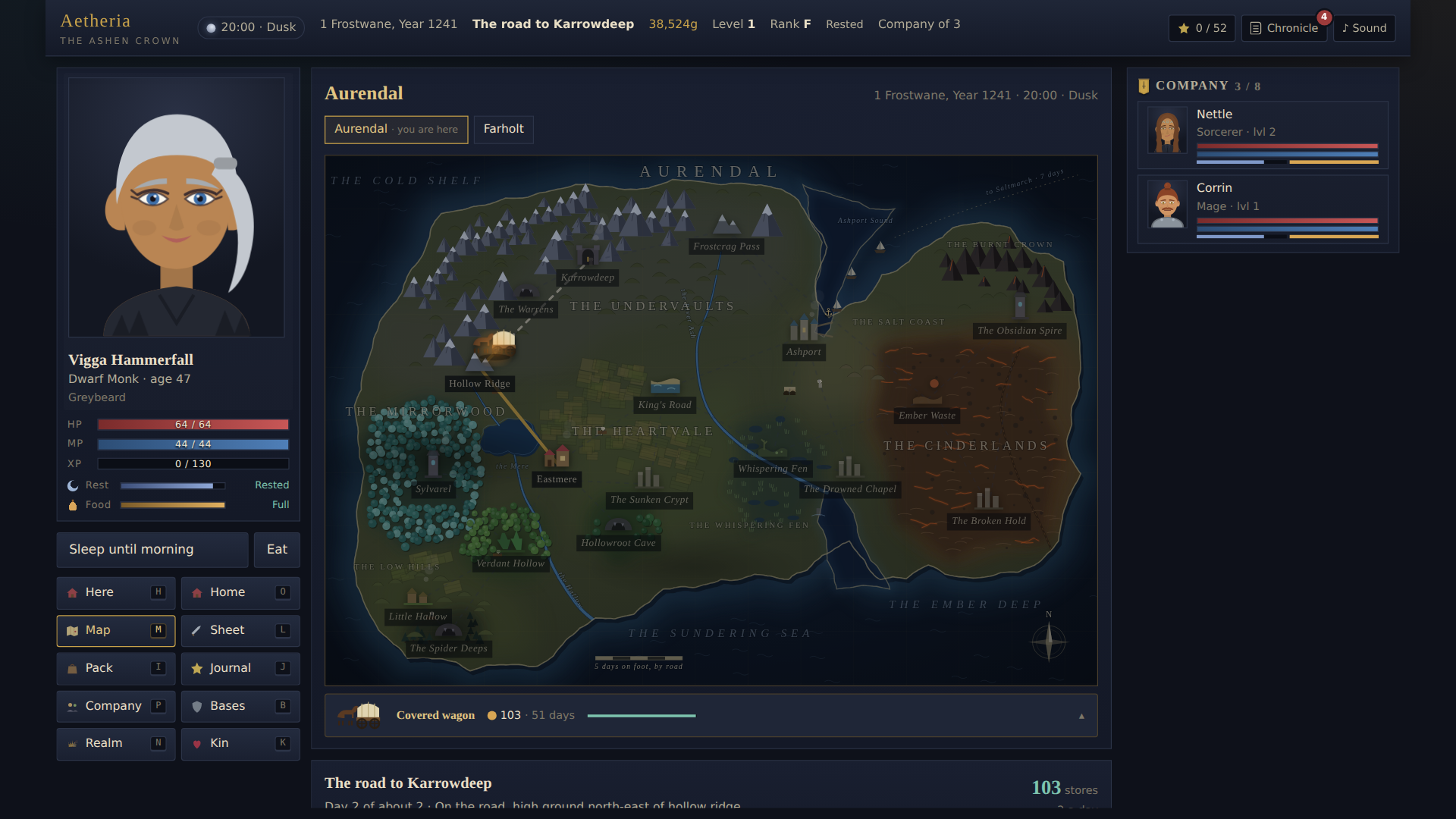

Buy a house and live in it. Marry — and decide first whether your purses are separate, shared, or split on divorce. Raise children who inherit your blood. Recruit a company of up to eight, pay their wages, earn their loyalty, and bury them when it goes wrong. Seat the ones who aren't adventuring with you at your company's seat, where they wait rested and fed and cost the road nothing.
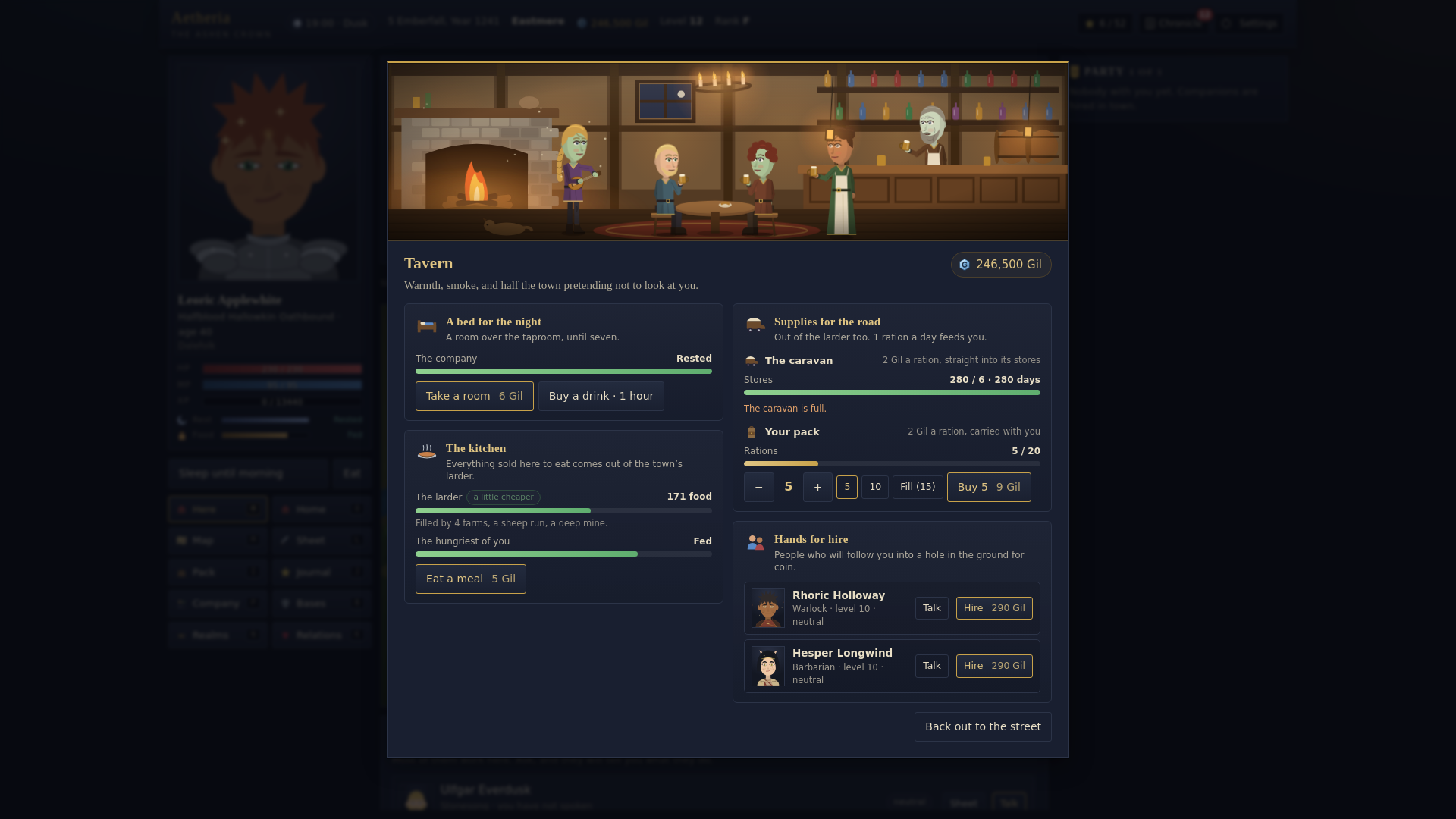
Every service window opens under a painted room, and the people in them have been drawn again from the ground up: faces turned three-quarters with eyes that blink, hands that hold things, each of them busy at something. The smith's hammer comes down as the sparks go off the anvil.

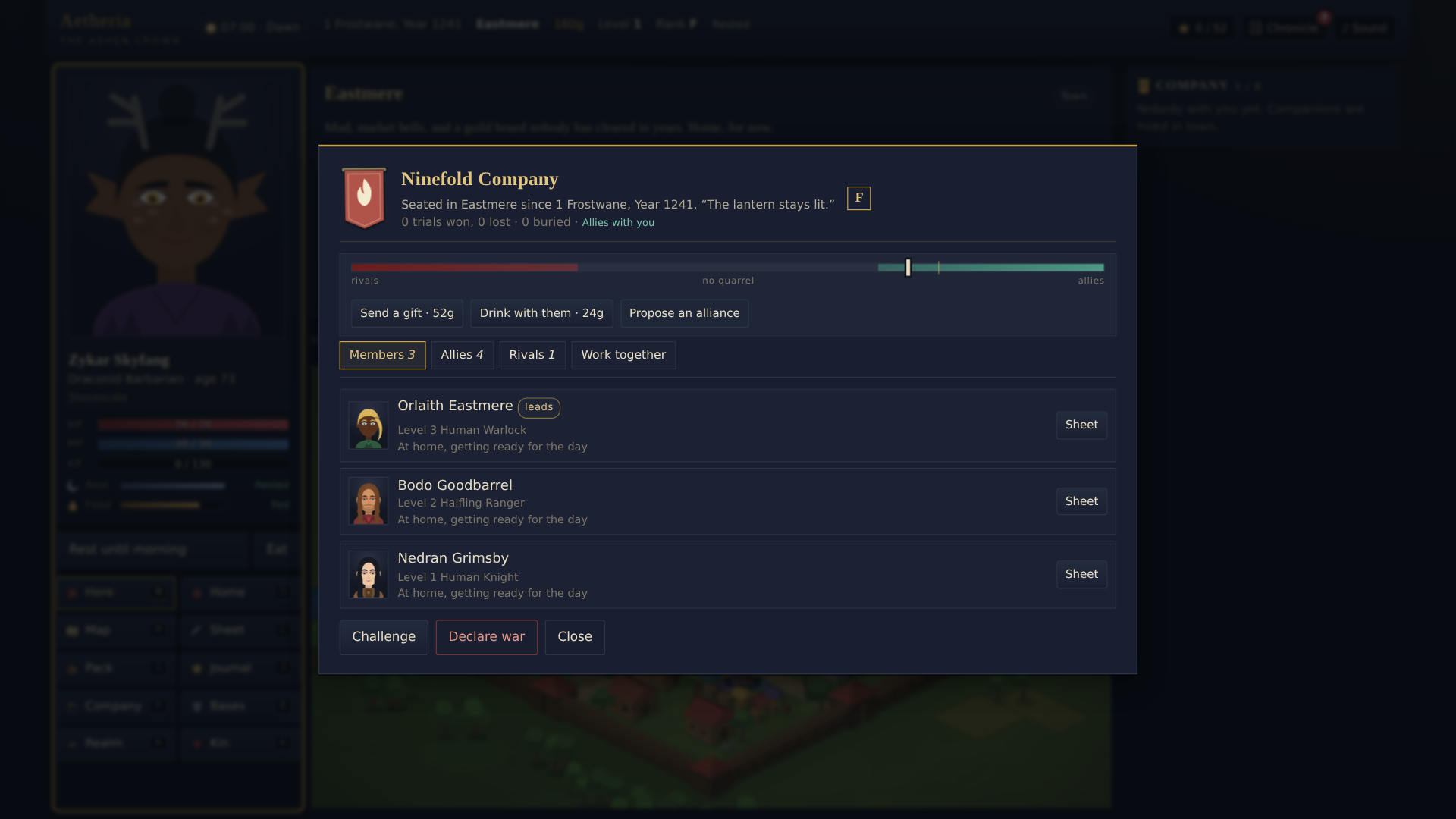
The companies that share the ladder with yours are real people under their own banners. They take contracts, bury their dead, and elect new leaders. They make friends and enemies of each other and of you. Send gifts, drink with them, swear an alliance and call them to your battles — or settle it in a Trial of the Yard. And they will poach your people: anyone underpaid or low on loyalty may be courted, and you hear the rumour about a week before they go. You can do the same to theirs.

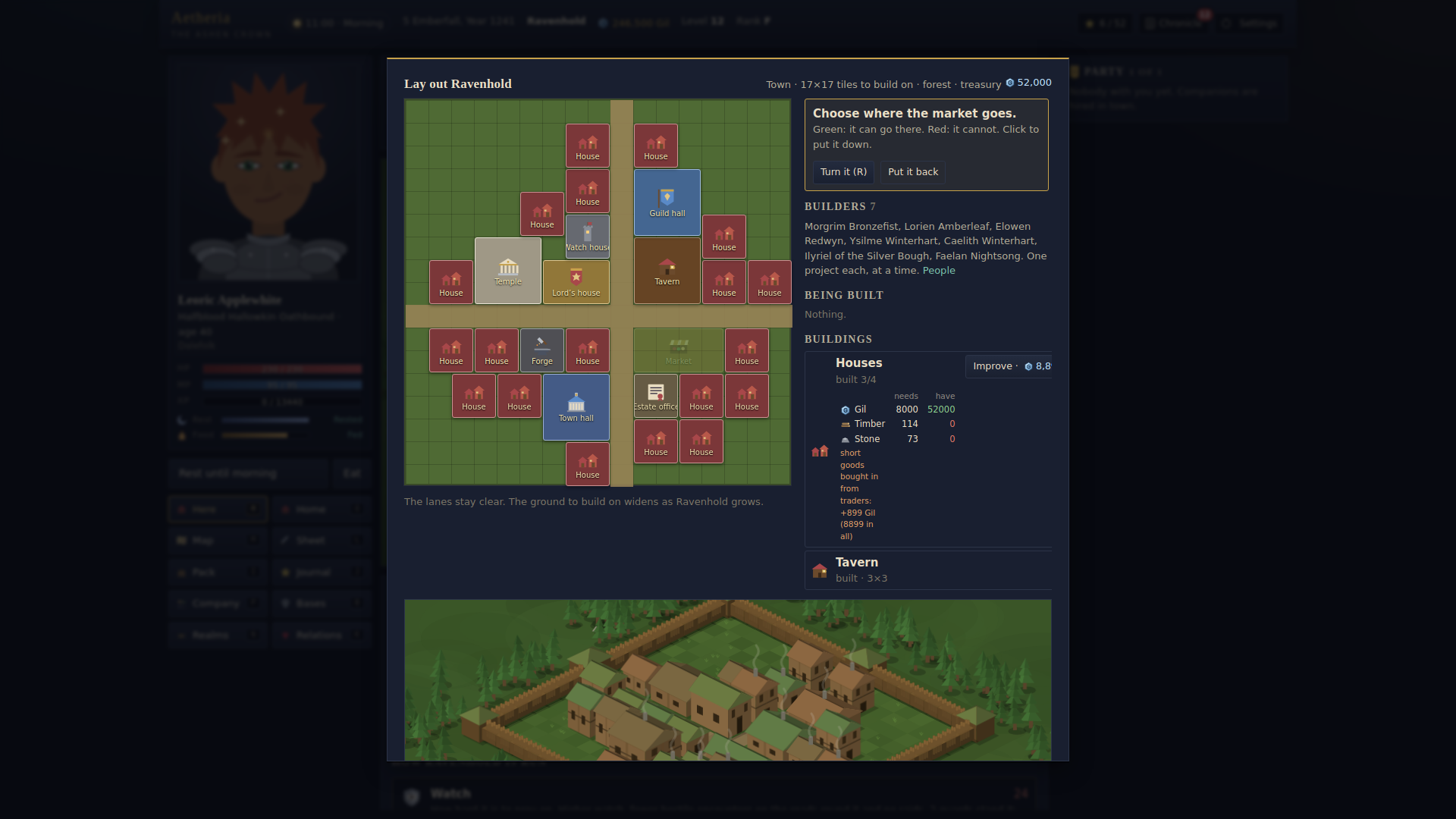
Found a settlement on open land and lay it out yourself, building by building, on a plan seen from above — the ground you can build on widening as the place grows from a camp to a city. Nothing builds itself: a builder is a resident whose trade is building, and one builder builds one thing at a time. Set your people to farming, mining, forestry, herding, the watch or the ledger. Raise farms, fisheries, quarries, mines and sheep runs, and run trade routes to any town on the same shore.
Write its rules: a base tax, different rates for any people or calling, who may live there at all, and up to three of eight laws — curfew, peace-bond, open gates, market day, tithe, levy, sanctuary, a guild charter for your own company. Every one of them costs something. Let order fall far enough and you get strikes, then riots, then a revolution.

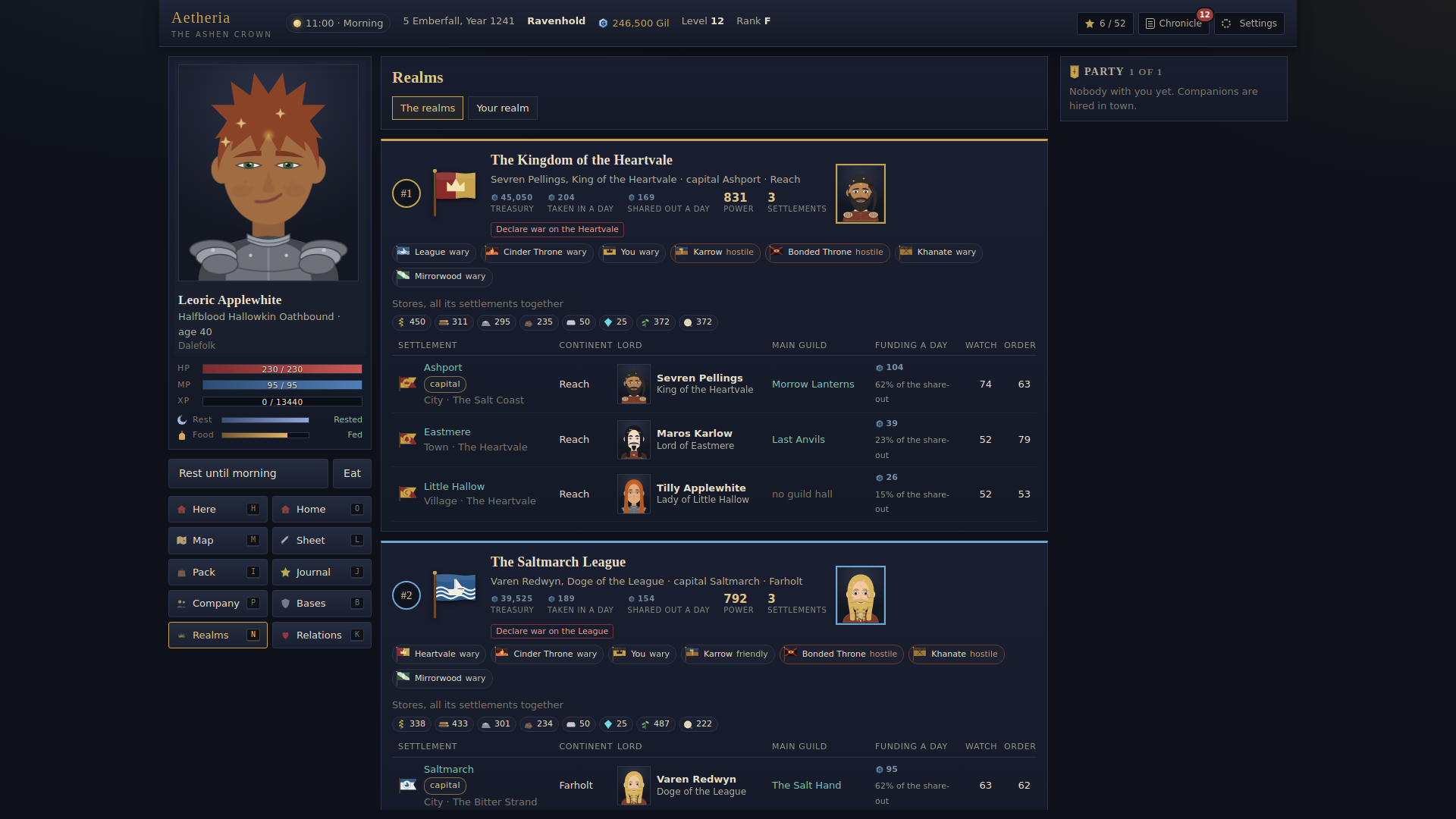
Seven realms hold the charted world: the Kingdom of the Heartvale, the Mirrorwood Court, the Karrow Holds, the Saltmarch League, the Bonded Throne, the Gorse Khanate and the Cinder Throne. Each has a flag, a treasury, a monarch who is a person living in their capital, and an opinion of every other realm and of you. Most of what a realm takes in goes back out to its seats; a town its realm can no longer fund slowly slips. Take a town and it leaves its realm for yours. Proclaim your own realm, design its name and flag, and join the list.

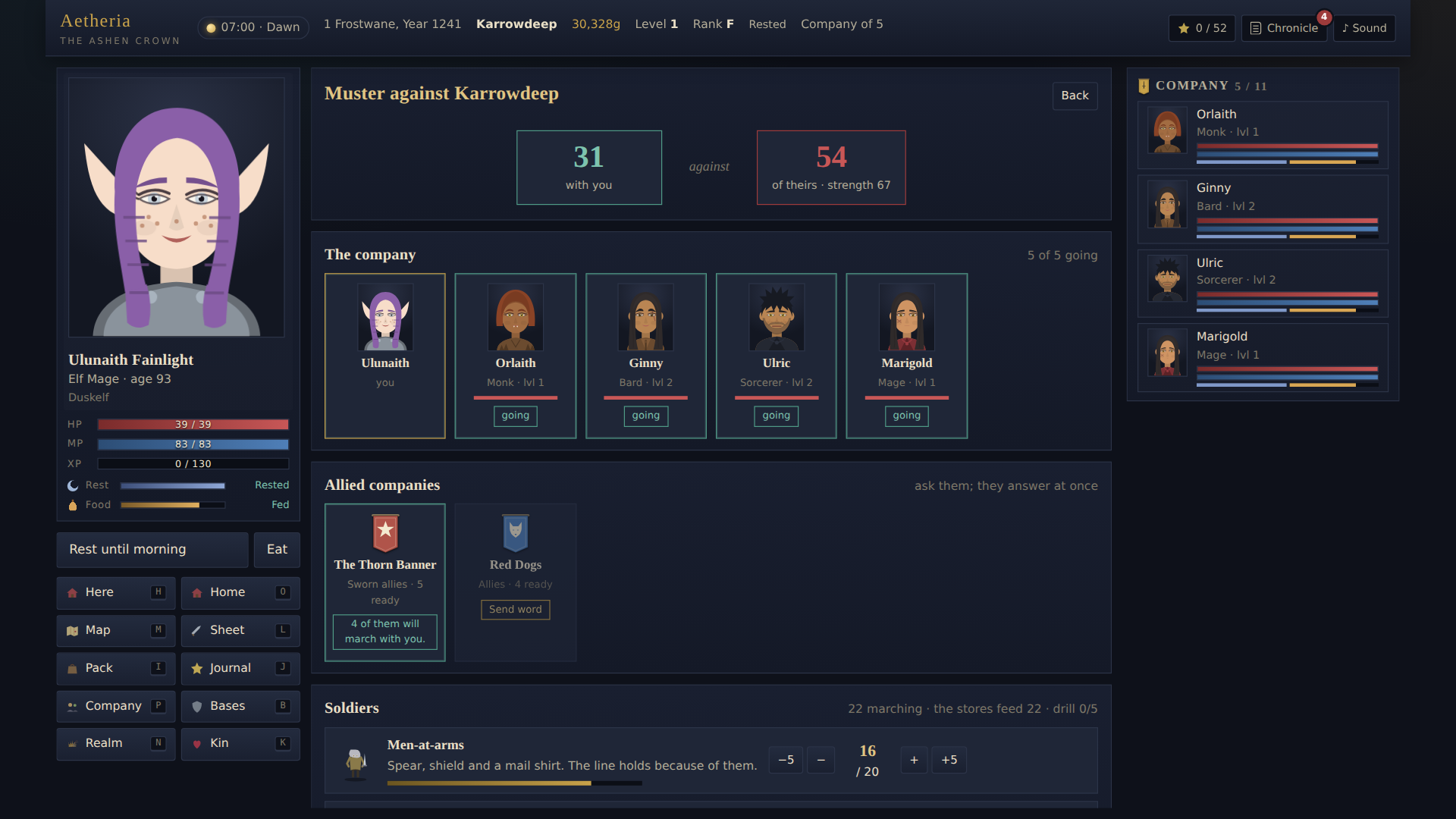
Declare war on a company or a town. At the muster, choose who goes: your company, the allied companies who answer your call, and as many men-at-arms, bowmen and knights as your stores can feed. Then lead them yourself onto a field of up to 22 by 12 squares, against the lord, the watch and everyone who will stand for them — or send them with orders and read the report. Many die, on both sides. When a town falls, take it, sack it, or burn it. A burned town is ash on the map with the day it burned on it — and whatever story ran through it ends there. Anyone's ashes can be built on again.

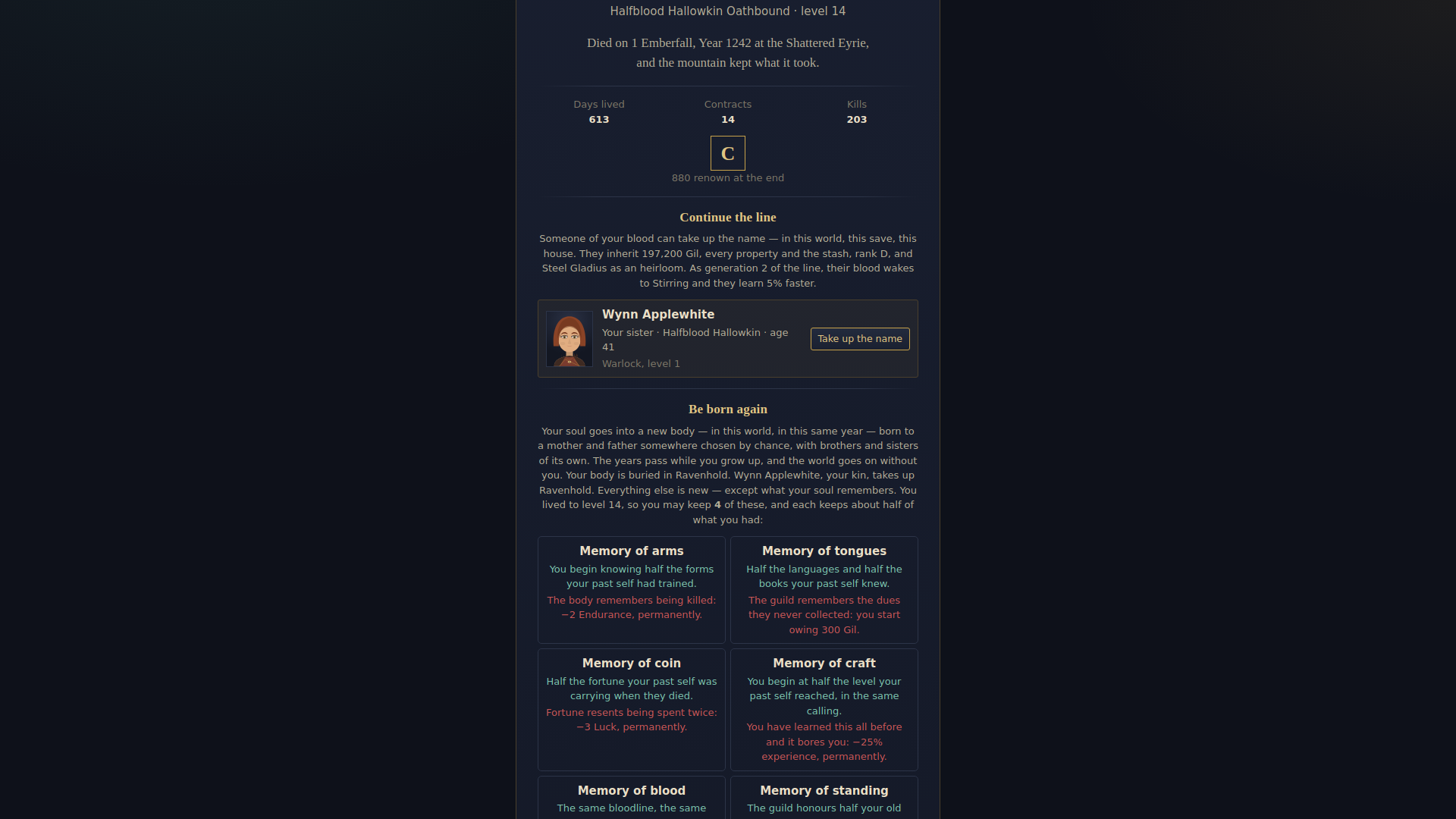
When you die you can take up the name as someone of your blood — or be born again in this same world, in the year you died. Your old self is buried where you were a citizen. What you held passes to your kin, and your settlements go on as free towns under them. You come back age 0, to a mother and a father, somewhere chosen by chance, and sixteen years pass while you grow up: the old die, lords and monarchs change, new kingdoms are proclaimed, companies rise and fall, and every one of those days is written down.
Everything about you is new except the memories you choose, and each is paid for: forms your body still knows, at the cost of Endurance; half your languages and a debt to the guild; half your money and your luck; half your old levels and a quarter of your experience forever; the same face in a body that ages twice as fast; your old rank, and a world a level harder.

This is an early release. Everything above is in and playable, from the first contract in Eastmere to the Crown of Aethelon: a main story of 22 chapters across two continents, 48 kinds of monster, 52 achievements. Expect rough balance, and please tell me what breaks — see the devlog for what to look for.

In the browser: press Run game, then use the fullscreen button. It is made for a desktop-sized window.
On Windows: download the zip, unpack it anywhere and run Aetheria.exe. No installer.
Saves live in your browser (or the app's own storage on Windows), one slot per life. Saves from v0.3 load as they are.
Keys: H Here · O Home · M Map · L Sheet · I Pack · J Journal · P Company · B Bases · N Realm · K Relations · C Chronicle · F2 Settings · F5 Save now · Esc closes a window. In a fight: Space ends your turn, A attacks, D braces, Tab switches tabs. Every key can be rebound in Settings.
Created and directed by Ariel Zaharoni.
Download
Click download now to get access to the following files:
Development log
- Aetheria v0.41 day ago
- Aetheria v0.32 days ago
- Aetheria v0.22 days ago
- Aetheria v0.13 days ago